If you’re planning to build a home in Bangalore, one of the first big decisions you’ll face is choosing between Turnkey vs Traditional Construction. It sounds like a small detail, but it actually shapes everything—your budget, your timeline, and how much stress you’ll go through before you finally get the keys to your new house. So let’s break this down in simple terms and figure out Turnkey vs Traditional Construction Which is Better for someone building in this city today.
What is Traditional Construction?
Traditional Construction in Bangalore is the method most people grew up seeing their parents or relatives use. You hire an architect separately, then a civil contractor, then an electrician, a plumber, a painter, and possibly an interior designer—each working somewhat independently. You, the homeowner, become the coordinator-in-chief. You’re the one chasing vendors, comparing material rates, checking on labour attendance, and resolving disputes when one contractor blames another for a delay.
This method has been around for decades and does offer flexibility. You can choose your own vendors, negotiate prices individually, and make changes on the fly. But it also comes with real headaches—unpredictable costs, inconsistent quality between different teams, and timelines that stretch far beyond what was originally promised.
What is Turnkey Construction?
Turnkey construction in Bangalore takes a completely different approach. Instead of managing five or six separate vendors, you work with a single company that handles everything—design, government approvals, civil work, electrical, plumbing, and interiors—under one roof and one contract. You literally hand over the plot, and the builder hands you back a finished home. That’s where the term “turnkey” comes from: you just turn the key and walk in.
This model has grown popular in Bangalore over the last few years, especially among working professionals who don’t have the time (or patience) to supervise a construction site every weekend.
Turnkey vs Traditional Construction Difference
So what’s the actual turnkey vs traditional construction difference? Here’s the simplest way to think about it:
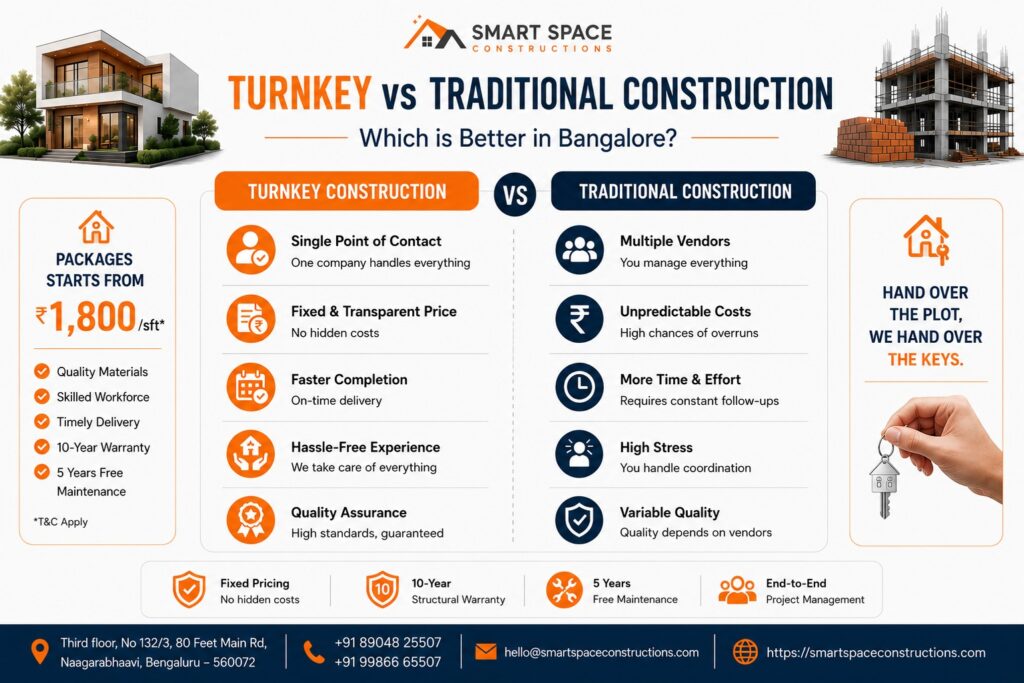
- Accountability: In traditional construction, if something goes wrong, contractors often point fingers at each other. In turnkey construction, one company is responsible for the entire outcome—there’s nowhere to hide.
- Cost predictability: Traditional projects are notorious for cost overruns because estimates are often vague. Turnkey builders usually provide a fixed, itemised quote upfront.
- Time investment: Traditional construction demands your constant involvement. Turnkey construction is designed to run with minimal supervision from you.
- Coordination: With traditional builds, you’re the project manager. With turnkey, the company assigns one.
Difference Between Turnkey vs Traditional Construction: Which Fits You?
The difference between Turnkey vs Traditional Construction ultimately comes down to how much control you want versus how much convenience you need. If you enjoy being hands-on, know the local vendors, and have the time to visit your site regularly, traditional construction might still work for you. But if you have a full-time job, live far from your plot, or simply want a stress-free experience with clear costs and timelines, turnkey is usually the smarter choice.
In a city like Bangalore, where traffic alone can eat up hours of your day, most homeowners today are leaning towards turnkey construction simply because it saves time, reduces disputes, and offers more predictable outcomes.
So, which is better in Bangalore?
There’s no one-size-fits-all answer, but for most modern homeowners in Bangalore especially those juggling careers and family life—turnkey construction tends to offer better peace of mind. It reduces the emotional and logistical burden of building a house, while traditional construction remains a viable option only if you genuinely have the time and expertise to manage it yourself.
Build Your Dream Home with Smart Space Constructions
If you’re leaning towards a hassle-free, turnkey experience, Smart Space Constructions is a name worth considering in Bangalore. They handle everything from design and BBMP approvals to civil work, electrical, plumbing, and interiors—all under one contract, with fixed pricing starting from ₹1,650/sft, a 10-year structural warranty, and 5 years of free maintenance included.
Get Your Estimated Construction Cost
With clear pricing and package options. No hidden charges, just a simple and realistic cost estimate
Contact Details:
Location : Third floor, No 132/3, 80 Feet Main Rd, Naagarabhaavi, Bengaluru – 560072
Call : +91 89048 25507 +91 99866 65507
Mail : hello@smartspaceconstructions.com
Website : https://smartspaceconstructions.com/
FAQs
1. What is the main difference between turnkey and traditional construction?
Turnkey construction bundles design, approvals, civil work, and interiors under one company and contract, while traditional construction requires hiring and managing multiple vendors separately.
2. Is turnkey construction more expensive than traditional construction in Bangalore?
Not necessarily. While the upfront quote may look higher, turnkey construction often saves money in the long run by avoiding hidden costs and delays common in traditional projects.
3. Which is faster—turnkey or traditional construction?
Turnkey construction is generally faster because one team manages the entire process without waiting on multiple contractors to coordinate with each other.
4. Can I customize my home with a turnkey builder?
Yes, most turnkey builders in Bangalore, including Smart Space Constructions, offer customization within their packages to match your design preferences.
5. Which option offers better quality control—turnkey or traditional?
Turnkey construction typically offers better quality control since one company is accountable for the entire build, from foundation to finishing.